
4.1 GW
Forecast for New Installation of Residential Solar Photovoltaic Systems in the United States in 2026
1.4 gigawatts
Forecast for new installed capacity of residential energy storage in the United States in 2026
40%
The proportion of photovoltaic systems equipped with batteries in the first three months of 2026
After President Donald Trump cancelled a key tax credit, the U.S. residential solar industry is facing a collapse in 2026. The equipment costs have risen, and the customer acquisition costs have soared even more. Homeowners are cautious about signing new loans and lease ownership models. However, the newly introduced supportive policies in Florida and the increase in battery installation rates will alleviate this downward trend.
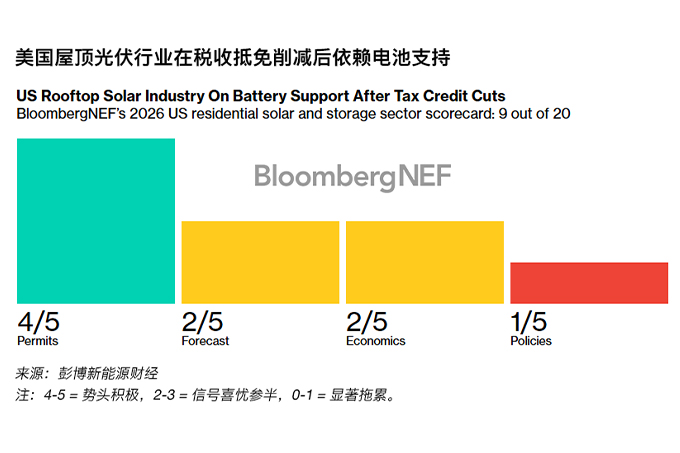
Bloomberg New Energy Finance predicts that the new installed capacity of residential solar power in the United States will reach 4.1 GW in 2026, a 15% decrease compared to 2025. Over the next 10 years, this market is expected to struggle to return to the record level achieved in 2023.
As of the first quarter of 2026, approximately 40% of residential photovoltaic systems in the United States have been equipped with battery storage, which is higher than the average of 35% in 2025. Bloomberg New Energy Finance predicts that due to the decline in the deployment rate of photovoltaic systems, the new installed capacity of storage in 2026 will decrease by 26% to 1.4 GW/3.8 GWh. However, there are already initial indications suggesting that the performance of these data is better than what our predictions imply.
Thanks to favorable policies and strong economic conditions, California and Florida are expected to become the two states with the largest household solar power installation capacity in the United States in 2026. Despite the continuous rise in electricity prices and the increasing rate of energy storage installations, these positive factors are still not enough to prevent the decline in other parts of the United States caused by policies.
The number of applications for photovoltaic project permits has increased by 34% compared to the first five months of 2025. However, some projects that submitted their applications late and failed to meet the eligibility requirements for tax credits may ultimately not be built. California and Florida are leading in the submission of permit applications.
Research Method: This report presents 10-year forecasts for the residential solar and energy storage markets in the United States by Bloomberg New Energy Finance. We have comprehensively utilized Bloomberg New Energy Finance’s proprietary database, profound understanding of industry development trends, as well as cost research, licensing data, and price predictions.