
On June 2, 2026, German virtual power plant operator Next Kraftwerke announced a five-year flexible management agreement with energy storage developer ECO STOR to market a large-scale energy storage project in Förderstedt.
Located in Saxony-Anhalt, Germany, the project is planned to have a capacity of 300MW and a total capacity of over 700MWh. The first 100MW unit is scheduled to enter the day-ahead, intraday, and balance electricity markets in November 2026, with the subsequent two 100MW units to be commissioned gradually. The entire project is expected to be fully operational by 2027.
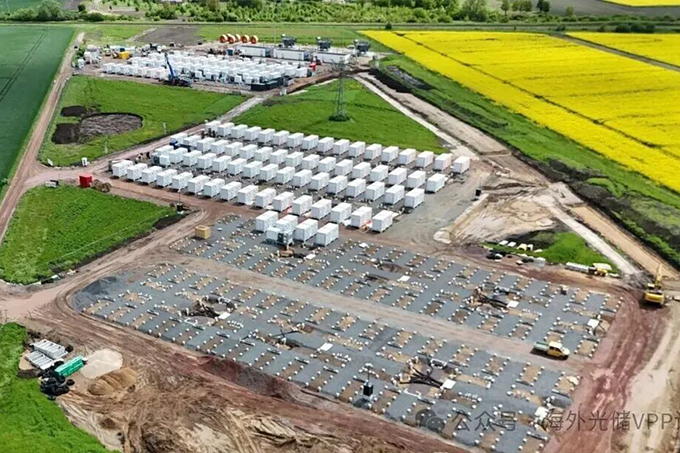
The real value of this news isn’t just that “Germany has built another large energy storage facility.” More importantly, it reflects a more mature asset organization model emerging in Germany’s large-scale energy storage sector: project owners are responsible for development and operation, while trading parties acquire dispatch and market optimization rights, and the revenue structure is split into stable and market-resilient components.
The value of energy storage is shifting from the battery cabinets themselves to who can better understand electricity prices, frequency, grid constraints, and risk allocation.
700MWh isn’t the key point; the 80% managed capacity is.
The figures for the Förderstedt project are impressive.
The ECO STOR project page reveals that this energy storage facility has over 600,000 cells, a maximum power output of 300MW, and a capacity exceeding 700MWh, designed to complete two full charge-discharge cycles per day. Next Kraftwerke’s press release also mentions that the project can power 500,000 homes in approximately two hours, or power 100,000 homes for 10 hours.
But the most crucial figures in this agreement are actually 80% and 20%.
According to Next Kraftwerke, the contract divides the project capacity into two parts: 80% of the battery capacity is managed under a custody agreement, while the remaining 20% continues to generate revenue at market prices. In other words, the project is not entirely exposed to electricity price fluctuations, nor is all upside potential locked in.
The custody agreement addresses the question of whether banks dare to trust the project.
For energy storage projects, the most difficult aspect to clarify has always been future cash flow.
If revenue comes entirely from spot arbitrage and market balancing, the model looks attractive, but banks and long-term capital will ask: Will price spreads be compressed? Will ancillary services lead to excessive competition? Will market rules change? Will grid connection restrictions affect dispatch?
The role of the custody agreement is to transform a portion of uncertain revenue into predictable revenue. Next Kraftwerke gains the right to use the energy storage capacity and is responsible for cross-market optimization; ECO STOR gains a more stable operating foundation, and the project is easier for investors and banks to understand.
This is the industry implications of this news: energy storage is transitioning from opportunistic projects into infrastructure assets that can be structured for financing.
Germany’s energy storage industry has truly entered a “multi-market optimization” phase.
Next Kraftwerke plays a crucial role.
This company is not simply a buyer and seller of electricity; it is a major player in Germany’s virtual power plant and flexibility trading systems. It will operate the Förderstedt project within the day-ahead market, intraday market, and balancing electricity market, scheduling charging and discharging based on price and grid signals.
This means that energy storage revenue will no longer rely on just one market.
During peak solar and wind power seasons with low loads, energy storage can absorb low-priced electricity; discharge in the evening or when the system is under strain; provide frequency regulation during frequency fluctuations; participate in balancing services during short-term imbalances; and provide reactive power support when the grid needs voltage support.
Trading capabilities are becoming a core asset for energy storage projects.
Previously, when evaluating energy storage, many people focused on cell cost, cycle life, and system efficiency. Now, when assessing large-scale energy storage in Europe, it’s essential to consider who operates it, who trades it, and who bears the risk.
The same power plant, handled by different trading teams, can have completely different revenue curves.
This is why trading and risk management capabilities like those of Next Kraftwerke and Shell Energy Europe are being brought to the forefront. The more large-scale energy storage projects there are, the more likely market price spreads will be squeezed by competition; the simple “buy low, sell high” model won’t always be comfortable. The truly scarce capabilities will become cross-market dispatch, risk hedging, grid connection constraint management, and real-time response.
The German case illustrates this change very clearly: project owners build assets, trading parties release asset flexibility, and financial institutions see clearer cash flow.
Flexible grid connection makes energy storage more like a grid tool.
Another detail shouldn’t be overlooked: ECO STOR has signed a flexible grid connection agreement with transmission grid operator 50Hertz.
This type of arrangement means that energy storage isn’t simply “charged and released as desired.” Project operation must consider ramp-up speeds, ancillary service limits, and grid constraints. Next Kraftwerke needs to incorporate these constraints into its optimization model to ensure the project is both profitable and serves the grid.
This precisely illustrates that the positioning of large-scale energy storage in Germany has changed.
It’s not just about profiting from price differences in the market; it’s also beginning to be seen by system operators as a tool for maintaining grid stability. It can absorb electricity during peak renewable energy periods, release power when the system is under strain, and provide frequency and voltage support.
For Chinese readers, the key takeaway from this case is that as the proportion of renewable energy continues to increase, the value of energy storage will not be determined solely by the price of battery cells. Grid connection location, dispatch rights, market access, trading capabilities, and contract structure will all collectively determine whether a project can become a financeable asset.
This may be what the next stage of energy storage in Europe will look like.
Another noteworthy aspect of the ECO STOR project is its entirely privately funded nature, with no public subsidies.
The Staßfurt city government mentioned in its 2025 project commencement announcement that the project is funded by investors such as NIC and X-ELIO, without using public subsidies; the project’s location will also share the profits through a tax mechanism. ECO STOR itself plans to establish 30 energy storage sites in Germany by 2030, with a total capacity of 10 GWh.
This indicates that German energy storage has entered a new phase: projects are no longer solely dependent on subsidies; capital is seeking replicable business structures.
This is the significance of Förderstedt’s approach. It places several key variables in a single case: large-scale projects of 700MWh, a revenue mix of 80% managed and 20% market-based, virtual power plant trading capabilities, flexible grid connection at 50Hertz, and unsubsidized private financing.
This isn’t just about a single energy storage power station becoming larger; rather, it’s about the increasingly complex organization behind energy storage assets, bringing them closer to the infrastructure where finance and electricity markets jointly price energy.
For the industry, declining battery costs are only the first step. The next real differentiator will be who can place a battery in the right market, the right grid node, and the right contract structure.