
197%
The income-to-capacity ratio of a one-hour, 200MW battery energy storage system integrated with a photovoltaic project
86%
The income-to-capacity ratio of the photovoltaic project with the installation of eight-hour, 200MW battery energy storage system
2.2 GW
The currently operational large-scale battery energy storage capacity that is paired with renewable energy sources
Due to the increasingly severe issue of renewable energy curtailment and the sharp increase in negative electricity prices, co-located and hybrid renewable energy and energy storage projects in Australia are expanding rapidly. Batteries that are paired with renewable energy assets can capture excess power generation and take advantage of price fluctuations for arbitrage, thereby improving the economic performance of the projects. However, it is necessary to weigh the benefits brought by battery storage against the increased project costs.
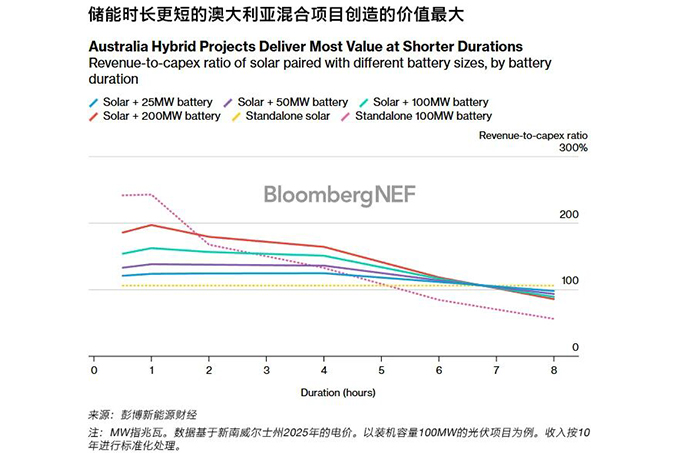
The model of Bloomberg New Energy Finance shows that under the current market conditions, installing battery energy storage systems for photovoltaic or wind power projects can enhance the economic performance of these projects, provided that the battery storage duration does not exceed six hours.
Currently, a 100MW photovoltaic project equipped with an energy storage system with a duration of one hour and 200MW batteries is expected to recover 197% of its capital expenditure within 10 years. For wind-storage hybrid projects, a 100MW wind power project equipped with an energy storage system with a duration of one hour and 200MW batteries can achieve the highest revenue-to-capital-expenditure ratio of 140%. However, due to the higher capital expenditure of wind power projects and their unique power generation curve characteristics, there are fewer arbitrage opportunities, and the overall return rate is still lower than that of the photovoltaic-storage hybrid projects.
To enhance the economic efficiency of long-duration energy storage batteries in hybrid projects, a greater fluctuation in electricity prices is required. Although batteries with longer storage times can increase total revenue, their higher capital expenditures may reduce the return rate. As volatility increases, the attractiveness of such batteries will increase; if volatility decreases, systems with shorter storage times may still be the preferred option.
Compared with standalone assets, co-location projects are increasingly favored, especially in the field of photovoltaics. By 2025, a total of 19 photovoltaic projects will be operational, and approximately half of them will be equipped with storage.
On the storage side, currently approximately 32% of the operational battery installation capacity is located in the same site as photovoltaic or wind power projects. As time goes by, storage will occupy an increasingly larger share of the total installed capacity of mixed projects and will exceed the proportion of renewable energy generation.