
Several European clean energy industry organizations have stated that the measures taken by the EU to restrict the fossil fuel supply chain and mitigate energy price shocks are welcome, but there are still many shortcomings.
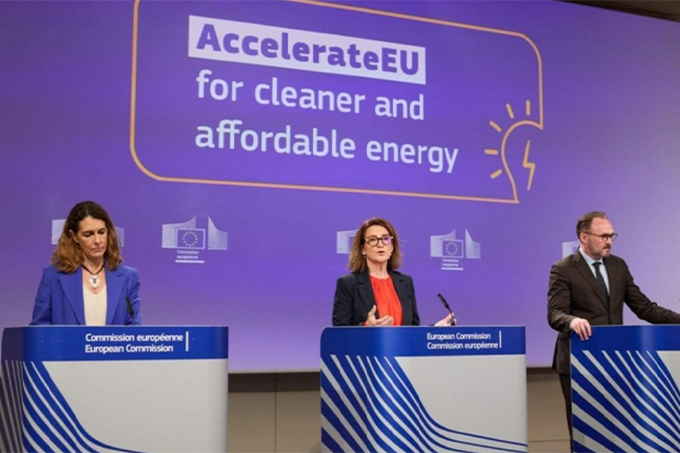
The Chief Spokesperson of the European Commission Paula Pinho, the Executive Vice-President for Clean, Fair and Competitive Transition and Competition Commissioner Teresa Ribera, and the Commissioner for Energy and Housing of the European Union Dan Jørgense (from left to right) “Launch the Accelerate the EU” plan
In the 50 days leading up to the outbreak of the conflict in the Middle East, Europe paid an additional 24 billion euros (approximately 28.09 billion US dollars) for fossil fuel imports, triggering the second energy price surge in five years. In response, the European Commission (EC) launched a set of measures called the “Emergency Policy Toolbox” on April 22nd, namely the “AccelerateEU” plan.
This toolkit includes: setting a unified electrification target covering the entire EU, supported by the Industrial Decarbonization Bank, and requiring EU member states to reduce electricity taxes. Additionally, the scale of the energy storage systems deployed by the EU needs to be significantly increased, reaching approximately 200 GW by 2030. This growth mainly relies on the deployment of battery energy storage systems.
The plan is called “AccelerateEU”. The President of the European Commission, Ursula von der Leyen, stated that this plan will provide immediate and structural relief measures for European citizens and businesses.
On one hand, this plan proposes suggestions for coordinating fuel inventory management at the level of EU member states, including underground gas storage, aviation fuel and diesel inventories, as well as targeted support for consumers. On the other hand, the plan also includes measures to accelerate the promotion of clean energy in Europe, such as promoting local manufacturing, investing in renewable energy, enhancing workers’ skills, driving economic electrification, and upgrading the power grid.
De Gucht said: “We must accelerate the transition to domestic clean energy. This will bring us energy independence and security, enabling us to better withstand geopolitical storms.”
The European Commission stated that although current energy security is not under threat, price fluctuations will affect EU citizens. Currently, 70% of the EU’s electricity comes from renewable power generation facilities and nuclear power plants, but overall, 57% of its energy consumption relies on imported fossil fuels. In 2025, the EU’s expenditure on imported fossil fuels will reach as high as 340 billion euros.
The “Accelerating the EU” plan is a response to the demands made by the heads of government of EU member states in March 2026. The EU leaders discussed these measures at a meeting held in Cyprus from April 23rd to 24th. These measures will be implemented concurrently with existing policies such as REPowerEU (which aims to reduce reliance on imports from Russia).
The European Commission recognizes that the projected 660 billion euros of investment needed for the energy transition by 2030 cannot be met solely through public funds. Therefore, it is seeking to mobilize private investment through the “Clean Energy Investment Strategy”. In the future, it will also organize the “Clean Energy Investment Summit”, inviting stakeholders from the financial services industry to participate.
The “Accelerating the EU” plan still lacks specific measures to encourage the application of energy storage systems.
Dries Acke, the deputy CEO of SolarPower Europe, responded to the above proposal by saying: “Electrification based on renewable energy is the most effective way for Europe to reduce its reliance on fossil fuel imports. The ‘Accelerate the EU’ plan has rightly placed this at the core of the EU’s crisis response.”
Although Acke welcomed the EU’s decision to set electrification targets and expand energy storage deployment, he pointed out that the European Commission failed to propose specific measures to achieve these battery storage and other non-fossil flexibility goals. He believes that these measures are crucial for reducing the impact of international natural gas prices on European electricity prices.
Acke stated that the European Photovoltaic Industry Association called for the establishment of a market-based mechanism to promote the utilization of non-fossil fuel flexible resources, thereby ensuring power supply and reducing wholesale electricity prices.
Meanwhile, Tina Strafela, the publicity director of the European Energy Storage Association (EASE), stated in a statement, “The Accelerating the EU” initiative has “sent a strong and systematic policy signal” regarding the importance of flexibility for the affordability, security, competitiveness and decarbonization of the EU’s energy.
The statement reads: “For the energy storage industry, this is of utmost importance: Energy storage is not only regarded as a driving force for decarbonization within the EU policy framework, but also considered as a strategic competitive asset. Energy storage technology is no longer just an ancillary topic for renewable energy; it is recognized as a strategic infrastructure – this sends a much stronger investment signal than mere renewable energy policies do.”
The European Energy Storage Association stated that although the energy storage industry is ready to take action, EU policymakers now need to demonstrate “equivalent ambition”. The association proposed a series of follow-up action suggestions, including: accelerating licensing approval, providing guidance to member states on improving grid integration measures, fairly implementing power market design rules, recognizing energy storage as an independent asset category and providing targeted capital support, promoting manufacturing and supply chain development, and advancing network charging and tax reforms.
Long-term energy storage technologies are still being overlooked.
The European Energy Storage Association also called for setting sub-goals for multi-day and seasonal energy storage within the framework of the EU’s target to deploy 200 GW of energy storage systems by 2030. It also demanded that long-term flexibility assessments be mandatory in the “National Energy and Climate Plans” (NECPs) of each EU country to identify “gaps in multi-day energy resilience”.
Just as discussed by Jacopo Tosoni, the policy director of the European Energy Storage Association, in a video interview at the “2026 EU Energy Storage Summit” held in London in February this year, EU member states need to submit flexibility demand assessment reports by July 1 this year. As part of the reform of the electricity market design, the assessment period has been extended until 2030. Based on these assessments, the EU will be able to make decisions on national assistance plans related to supporting investments in flexibility resources, including energy storage.
However, as Tosoni and the European Energy Storage Association previously pointed out, these assessments do not take a long-term perspective into account, and in most of the high-level discussions within the EU, there is also a lack of clear mention of the duration of the energy storage system.
The European Flow Battery Association (FBE) also welcomed the “Accelerating Europe” plan and its recognition of the role of energy storage systems. However, it warned that if the key tool of long-term energy storage systems continues to be ignored, Europe will face the risk of “repeating the same mistakes”.
The European Flow Battery Association pointed out that in the “Accelerating the EU” document, only short-term battery energy storage systems and pumped hydro power generation facilities were mentioned as energy storage solutions. The association insisted that many long-term energy storage manufacturers have established a presence in Europe and have diversified supply chains. The association believes that if policymakers fail to explicitly incorporate long-term energy storage systems in subsequent measures and do not treat long-term energy storage technologies like strategic technologies in net-zero investments, procurement, the grid, and flexibility in the same way as they do for photovoltaic module manufacturers and lithium-ion battery producers, then these manufacturers will repeat the mistakes made by previous photovoltaic module manufacturers and lithium-ion battery producers.