
Recently, the International Renewable Energy Agency (IRENA) released a report titled “Round-the-Clock Renewable Energy: The Economics of Reliable Wind and Solar Power Generation”. This report provides a reliable calculation and assessment method for evaluating and comparing the costs of round-the-clock renewable electricity, and also analyzes the cost trends, cost drivers, and regional differences of integrated wind, solar, and storage power generation.
Integrated solution for power generation, energy storage and utilization
Have obvious cost competitiveness
This report confirms that the combination of solar energy, wind energy and battery storage has achieved reliability and can provide round-the-clock electricity in an economically efficient manner. In regions with excellent wind and solar resources, the integrated solution with energy storage can achieve round-the-clock power supply, and its cost is already lower than that of fossil fuel power generation. At the same time, as the penetration rate of renewable energy in the power system continues to increase, the core challenge of the energy transition increasingly focuses on adequacy and flexibility. Therefore, this report introduces the reliable levelized cost per kilowatt-hour as an evaluation benchmark, further confirming that compared to fossil fuels, the integrated solution of wind, solar and storage has a significant cost advantage under round-the-clock power generation conditions.
The cost of battery storage has decreased by 93%
From the perspective of technology type, driven by the decline in costs of photovoltaic power, wind energy and battery energy storage systems, the reliable cost has rapidly decreased.
From 2010 to 2024, the cost of photovoltaic systems decreased by 87%, dropping to $708 per kilowatt; the cost of onshore wind power systems decreased by 55%, falling to $1066 per kilowatt. The cost of battery storage decreased even more significantly, dropping from $2634 per kilowatt-hour in 2010 to $197 per kilowatt-hour in 2024, a reduction of 93%. Recent industry surveys indicate that this downward trend will accelerate further in 2025, with the price of turnkey systems dropping by approximately 30% within one year, reaching the lowest level on record. It is expected that in the next five to ten years, continuous technological development, expansion of manufacturing scale, and maturity of the supply chain will drive further cost reduction for these three technologies.
Photovoltaics + Energy Storage: 54 to 82 US dollars per MWh
Wind power + energy storage: $59 to $94 per MWh
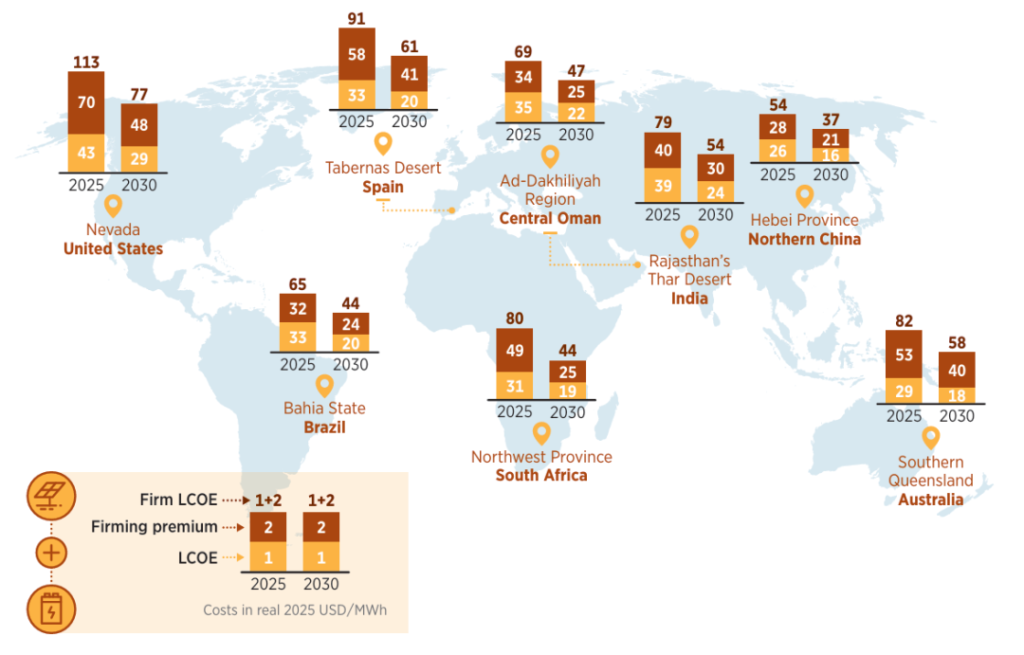
The reduction in construction costs has simultaneously led to a decrease in the reliable cost. In regions with high-quality wind and solar resources, the reliable cost of photovoltaic combined with energy storage systems has dropped from over $100 per megawatt-hour in 2020 to $54 to $82 per megawatt-hour in 2025. The cost of new gas-fired power generation globally has exceeded $100 per megawatt-hour. It is expected that by 2030, the reliable cost will decrease by approximately 30%, by 2035 by about 40%, and by 2035, the reliable cost in the location of the best-performing projects will be lower than $50 per megawatt-hour. Moreover, the construction period is also shortening. In most markets, projects can typically be completed within one to two years after obtaining permission and grid connection, much faster than new gas-fired power generation projects.
The wind power + energy storage system also demonstrates strong competitiveness. According to IRENA’s estimation, in 2025, the reliable cost of wind power + energy storage in Inner Mongolia, China, is approximately $59 per megawatt-hour. In Brazil, Germany and Australia, it is $88 to $94 per megawatt-hour. It is expected that by 2030, the cost in these markets will drop to approximately $49 to $75 per megawatt-hour.
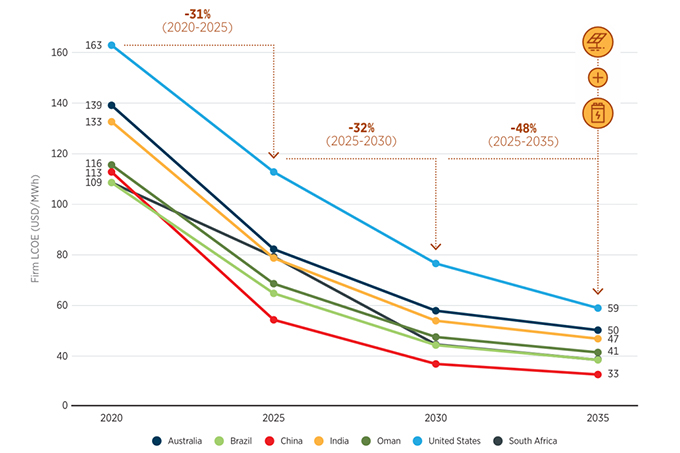
The cost of photovoltaic storage is gradually becoming comparable to that of fossil energy.
From a global perspective, China has defined the lower limit of reliable power costs for “photovoltaics + energy storage” on a global scale.
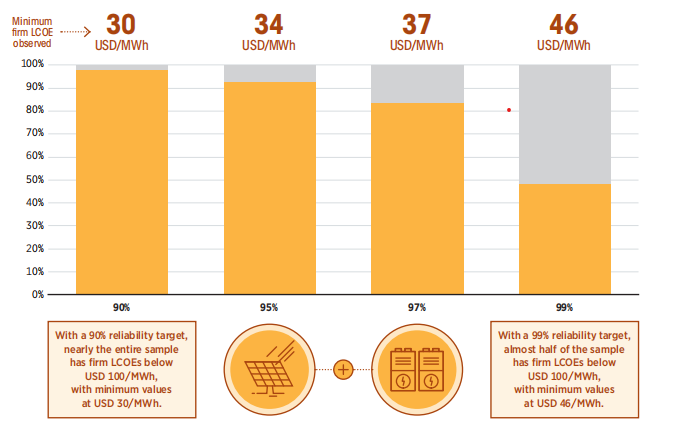
IRENA’s simulation of 252 large-scale photovoltaic projects to be operational in China by 2024 shows that the vast majority of these projects can provide reliable electricity at a cost lower than $100 per megawatt-hour (see the figure below). Among the project samples, when the reliability target is 90%, the lowest reliable cost can be as low as $30 per megawatt-hour; if the reliability target is raised to 99%, this cost only increases to approximately $46 per megawatt-hour. Even under the highest reliability target, more than half of the projects have costs below the baseline of $100 per megawatt-hour. In the United States, the cost of building new combined-cycle gas turbines has reached a record high of $102 per megawatt-hour – which is roughly equivalent to the cost of reliable solar and wind power generation in resource-rich regions with a reliability target of 90%-95%; in Saudi Arabia, the photovoltaic + energy storage system can achieve near continuous power supply, and its reliable power generation cost is approximately $70 per megawatt-hour – even with low fossil fuel prices in the country, photovoltaic + energy storage is more cost-competitive than combined-cycle gas power generation. Additionally, the reliable power generation costs in Brazil, India, South Africa, Australia, and the Gulf region are also rapidly decreasing and are gradually approaching the cost of fossil energy power generation.
The main factors influencing the reliable cost
The report analysis reveals that the key factors influencing the reliable cost include geographical resource conditions, technical costs and reliability targets.
Among them, the quality of resources and the local weather patterns are the primary determining factors. At the same time, as the costs of photovoltaic power, wind power and battery storage decrease, the overall cost range of the system is continuously lowering, but the specific trajectory is affected by the quality of resources and financing conditions.
Furthermore, the selection of reliability targets is of utmost importance: at a medium reliability level of 80-90% (in high-quality resource areas), the integrated power generation system can economically and efficiently meet the demand; beyond this threshold, the cost increases non-linearly, and for each additional percentage point increase, a disproportionately larger amount of energy storage or redundant capacity needs to be added. Therefore, for most industrial and commercial users, a reliability range of 80-90% is the most cost-effective balance point; for users with high requirements such as data centers, hospitals, and precision manufacturing, they need to simultaneously configure dispatchable renewable energy or other backup solutions.
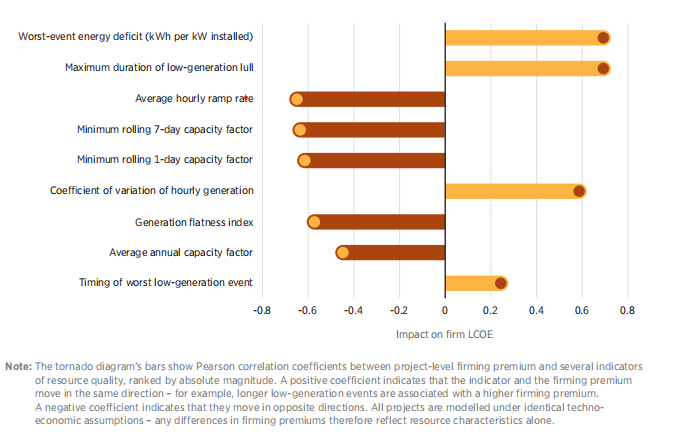
Resource-related drivers of the firming premium for solar PV

Impact of declining technology costs on the firm LCOE of solar PV and BESS
Strategic value beyond cost advantages
In areas with abundant resources, the integration of wind, solar and energy storage can already provide reliable electricity around the clock at costs no higher than, or even lower than, those of newly-built fossil energy facilities. However, this does not mean that every generator must be “reliable” – if the transmission grid, energy storage, demand response and other aspects are sufficiently flexible, they can also support the grid connection of a high proportion of renewable energy systems. Project-level reliable power plays a more prominent role in three scenarios: grid access restrictions, continuous power supply required by users, or urgent need for rapid expansion by users while the traditional power sources have a long cycle. The integrated wind, solar and energy storage system typically takes only 1-2 years from approval to operation, much faster than gas-fired power generation, and can also reduce grid upgrade investment by utilizing existing connection points.
Apart from its economic advantages, round-the-clock renewable electricity also has other strategic values. Recent geopolitical shocks have highlighted that relying on imported fossil fuels exposes economies to price fluctuations and supply disruptions beyond their control. Against this backdrop, renewable electricity, especially comprehensive round-the-clock power systems, offers a different solution: such systems, due to the localization of power generation resources and low marginal costs of generation, have long-term prices largely decoupled from the global commodity market, and can reliably and flexibly provide electricity at predictable and continuously decreasing costs, thus providing a natural hedge against fossil fuel price fluctuations for any large-scale power users.
As power generation technologies become increasingly mature and costs continue to decline, how to realize their potential increasingly depends on supportive policies and strategies. In many countries, the electricity market, grid infrastructure, and procurement policies have not yet fully reflected the value that integrated renewable energy systems can provide. Measures such as market design and reform to highlight the value of flexibility and reliable power supply capabilities will determine how quickly the cost reduction of renewable energy generation can accelerate the deployment of renewable energy worldwide and effectively reduce countries’ reliance on fossil fuels.