
Starting from April 2026, the Transmission Network Operator Surcharge (TNUoS) in the UK will witness the largest increase in history – with an annual average increase of over 60%. The total revenue of TNUoS in the 2026/27 fiscal year will soar from approximately 5.1 billion pounds to 8.9 billion pounds, and it is expected to further increase to 13.6 billion pounds in the 2030/31 fiscal year. This reform, which began with the RIIO-ET3 price control, is reshaping the cost structure of the UK’s power system. For power industry investors who are heavily investing in new energy and data centers, what does the sharp increase in TNUoS costs mean? Based on the research of NESO, Ofgem and several energy consulting institutions, this article provides a deep analysis of the internal logic behind the increase in UK grid connection fees and its impact on project investment.
01
The largest increase in 60 years
On April 1st, 2026, the Transmission Network Operator Surcharge (TNUoS) in the UK will officially adopt new rates. How significant is this change? Let’s take a look at some figures:
The total revenue of TNUoS has soared from approximately 5.1 billion pounds in the 2025/26 fiscal year to around 8.9 billion pounds in the 2026/27 fiscal year, representing an increase of nearly 75%. And this is just the beginning – by the 2030/31 fiscal year, this figure is expected to exceed 13.6 billion pounds. This means that over the five-year period from 2026 to 2030, the cumulative increase for TNUoS will be approximately 69%.
The impact on individual users is more straightforward. For large energy consumers, the electricity cost for the 2026/27 fiscal year will increase by 5% to 10%. For a large enterprise with multiple sites, the average annual TNUoS cost per electricity meter will increase by 17,000 to 82,500 pounds; the cost increase for a single large site could even exceed 300,000 pounds per year.
This is not just a change in numbers. The proportion of TNUoS in the electricity bills of ordinary British households will double from the current approximately 5.8% to 10.6% – almost all electricity users will feel the impact of this transformation.
02
Reasons for price increase: Who will bear the cost of energy transition?
RIIO-ET3 price Control: The “Harvest Season” for Power Grid Companies
The root cause of this increase lies in the RIIO-ET3 price control mechanism introduced by Ofgem (the Office of Gas and Electricity Markets in the UK). RIIO stands for “Revenue = Incentive + Innovation + Output”, and this is the regulatory framework implemented by the UK for power transmission network operators.
In the 2026/27 fiscal year, the permitted revenue of the transmission operator soared from 5.1 billion pounds in the previous year to 7.61 billion pounds, representing an increase of nearly 50%. These additional revenues were ultimately passed on to all electricity users through TNUoS – both power generators and consumers.
Grid Upgrade: The Cost of Integrating Offshore Wind Power
The UK is experiencing an unprecedented wave of investment in new energy. To achieve its climate goals, the government plans to double the installed capacity of offshore wind power by 2030 – behind this ambitious goal lies a huge investment in the power grid infrastructure.
The new high-voltage transmission lines, substations, and network reinforcement projects – these investments require someone to foot the bill. TNUoS is the mechanism that distributes these costs among all electricity users.
Residual cost of requirements: New logic for fixed costs
In this round of reform, the most significant change is “Demand Residual Fee” (DRF). This is a fixed fee that is not related to the amount of electricity used – you have to pay it regardless of whether you use a lot or a little.
In the 2025/26 fiscal year, the residual demand cost was 3.8 billion pounds; in the 2026/27 fiscal year, it soared to 7.5 billion pounds, an increase of 94%. For enterprises with stable electricity consumption, this cost increase means that even if you do your best to save energy, the TNUoS portion of the electricity bill is difficult to reduce.
03
Who Suffered the Most: An Industry and Regional Perspective
The first and foremost industry
Not all industries were affected to the same extent. The following categories of users felt the impact the most strongly:
Data centers are one of the “hard-hit areas”. As major electricity consumers, data centers have extremely high and stable electricity consumption, which means they cannot avoid the increase in fixed costs by “using less electricity”.
The manufacturing industry and logistics enterprises are also facing severe challenges – these industries typically have a large number of energy-intensive equipment and have extremely high requirements for the stability of power supply.
Any enterprise with high-load operations and “half-minute intermittent metering” is within the affected range. Enterprises with multiple sites and high electricity consumption are particularly suffering.
Geographical differences: The prices are higher in the south.
Another major feature of TNUoS is the regional disparity. As the power generation facilities in the UK are mainly concentrated in the north and west, while the population and economic centers are in the south, users in the southern regions have to pay a higher “location rate”.
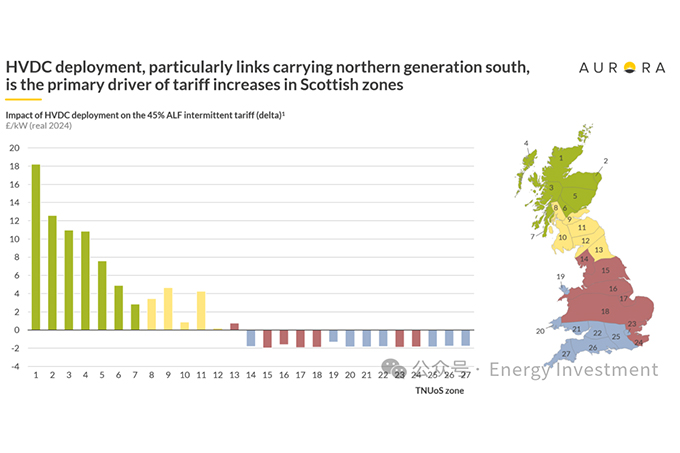
Specifically, users in South Wales, the southwestern part of the UK, and the southeastern part of the UK are facing the highest TNUoS costs. If you are operating energy-intensive projects in these areas, you need to pay special attention.
04
Five-year outlook: Has the upward trend peaked?
From the 2026/27 fiscal year to the 2030/31 fiscal year, the cost of TNUoS in the UK will experience a continuous increase. Over a period of five years, there will be an approximate 69% increase – this is unprecedented in the history of the UK’s power industry.
But this also brings about a question: When will the growth rate peak?
Based on the current situation, the increase in TNUoS is closely related to the investment cycle of the power grid. The UK plans to significantly increase the installed capacity of new energy sources by 2030, which means that grid investment will remain at a high level in the coming years. The optimistic scenario is that after 2030, as the main power grid infrastructure is completed, the growth rate may gradually slow down.
Of course, this also depends on various factors such as whether the policies are adjusted, changes in electricity demand in the British economy, and the trend of costs for new energy sources.
05
Implications for Investors
The project financial model must be re-evaluated.
For any power project carried out in the UK – whether it is wind power, solar power or energy storage – the TNUoS cost must be included in the core assumptions of the financial model.
It is recommended to use 13.6 billion pounds (the forecast for the 2030/31 fiscal year) as the benchmark for the stress test. If your project has a high dependence on the power grid, you should allocate sufficient cost buffers.
The site selection strategy needs to be re-examined.
Geographical location is becoming a key variable in the feasibility of projects. The relatively lower TNUoS costs in the northern and western regions make it more economically viable to develop new energy projects in these areas.
Of course, this requires a comprehensive consideration of resource conditions (wind resources, solar resources). However, for energy storage projects, a site selection strategy that is closer to areas rich in renewable energy may be more sensible.
Distributed and Self-built: A New Approach to Reducing Dependency
Facing the continuously rising TNUoS, enterprises are seeking “self-rescue” strategies.
Installing rooftop photovoltaic and energy storage systems can, to a certain extent, reduce reliance on the power grid, thereby lowering TNUoS exposure. For enterprises with the conditions, this is not only a cost optimization but also a choice for energy security.
The necessity of long-term contracts
For electricity buyers, when signing long-term PPA (power purchase agreement) contracts with power generators, it is necessary to clearly define the cost-sharing mechanism for TNUoS. Otherwise, if TNUoS increases, the economic viability of the contract may deteriorate rapidly.
06
Conclusion
The sharp increase in TNUoS in the UK is essentially the “cost realization” of the energy transition.
On one hand, the UK needs a huge amount of investment to upgrade its power grid in order to accommodate more renewable energy connections and achieve its climate goals; on the other hand, these investments are being passed on to all electricity users through the TNUoS mechanism – whether they are households or businesses.
Site selection strategies, contract designs, and financial models – all of these need to incorporate TNUoS as a core consideration. Those enterprises that can flexibly cope with rising costs will gain an advantage in the competition.