
Shipping traffic in the Strait of Hormuz came to a sudden halt.
The tracks of several super oil tankers heading towards the Persian Gulf were frozen at the entrance of the strait, serving as a vivid illustration of the sudden escalation of the geopolitical situation in the Middle East, and reminding us that crude oil, this “industrial blood”, has never been far from the core of politics.
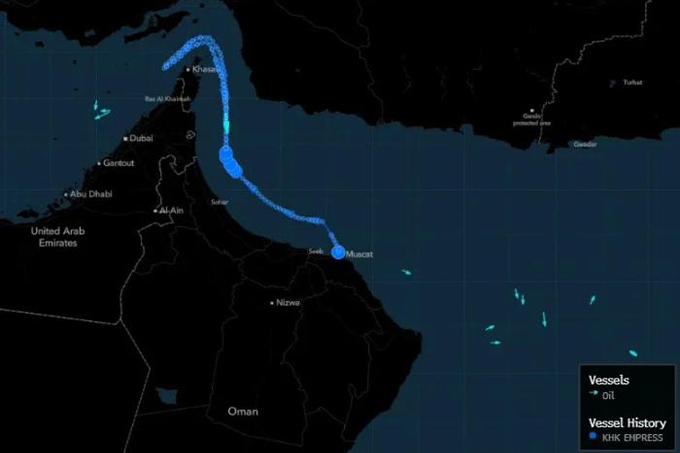
On February 28th, the KHK Empress oil tanker turned around in the Strait of Hormuz, while other vessels waited outside the waterway.
“The pricing logic of international oil prices has shifted from being driven by supply and demand to being driven by geopolitics,” Wan Zhe, a professor at Beijing Normal University and an economics expert, told Sanlihe. Geopolitical premiums are the core driver of the short-term upward trend in oil prices.
Since the beginning of this year, international oil prices have been fluctuating between two forces: On one hand, the market generally expects a global supply surplus, which has intensified bearish sentiment; on the other hand, geopolitical tensions surrounding Iran have pushed up the risk premium.
Before the recent escalation of the situation in the Middle East, the global crude oil market was in a state of oversupply. The International Energy Agency (IEA) predicted that there would be a 3.73 million barrels per day supply surplus in 2026, accounting for approximately 4% of global demand.
The outbreak of the conflict has disrupted the original pricing logic. Since mid-February, international oil prices have embarked on a rapid upward trajectory. The WTI crude oil futures for the current month’s consecutive contracts rose by more than 3% in a single day, reaching a new high in the past six months; the Brent crude oil price also approached the $75 per barrel mark, and the geopolitical risk premium continued to rise.
The resource control at the production end and the circulation control at the shipping route end have formed a global energy “dual-core” game system.
The Strait of Hormuz carries approximately one-fifth of the global maritime transportation of oil and liquefied natural gas every day, making it a vital artery for global energy. In the event of a conflict causing shipping disruptions, the global oil supply could face a daily shortfall of 18 million barrels.
The analysis suggests that if Iran were to cut off shipping through the Strait of Hormuz, with the additional support of the peak demand season, international oil prices could potentially reach $100 per barrel.
However, given the complex geopolitical and economic costs involved in the Strait of Hormuz, the probability of this worst-case scenario being triggered is rather low.
Wang Lei, an assistant researcher at the Institute of World Economics and Politics of the Chinese Academy of Social Sciences, said that from the perspective of capability and cost, “completely and continuously blocking” the Strait of Hormuz would be a highly risky and self-destructive move for Iran. It would simultaneously impact the major buyers of energy that rely on the strait and the surrounding countries, and might trigger more intense military escort and anti-blockade actions.
Wan Zhe also believes that in the long term, the impact of the conflict on the global supply and demand pattern of crude oil will still be limited and will ease relatively soon.
Although Iran is the third-largest oil producer in the Organization of the Petroleum Exporting Countries (OPEC), its crude oil output accounts for only 3% of the global crude oil supply. Under the pressure of global oversupply of crude oil, its impact on international oil prices is relatively limited.
“OPEC+” has also provided a certain degree of mitigation mechanism for oil price fluctuations. Currently, “OPEC+” is still implementing a production cut strategy to maintain prices, and has continuously suspended the increase in production for the first three months of this year. If oil prices continue to rise sharply and the supply gap widens, “OPEC+” can activate the production increase contingency plan.
According to previous market reports, some representatives of the “OPEC+” group indicated that they expect to agree to moderately resume oil production increase when they hold a meeting to review the policies for April. This might be related to the recent tensions between the United States and Iran, which have pushed up oil prices. The current price level has already exceeded the psychological bottom line of the main member countries of the “OPEC+”.
In the long run, this situation may have complex effects on the global pace of energy transition.
Wan Zhe analyzed that if the chaotic situation in the Middle East persists, some countries may postpone their radical coal and oil reduction policies and even increase the exploration and development of their own traditional energy resources. At the same time, the high oil prices will objectively enhance the economic viability of photovoltaic, wind power, energy storage and new energy vehicles.
“Over the long term, the conflicts in recent years have further highlighted the vulnerability of the global energy supply chain,” Wan Zhe said. “Countries may further strengthen their energy self-reliance strategies and accelerate the layout in areas such as grid independence, distributed energy, and hydrogen energy, thereby promoting the overall process of global energy transformation.”