
Recently, the well-known Danish investment firm, Copenhagen Infrastructure Partners (CIP), announced that its 500MW/1GWh Coalburn 1 battery energy storage project in South Lanarkshire, Scotland, has officially entered commercial operation. The project was deployed at the former coal mine site and uses lithium-ion batteries. CIP, through its flagship fund “Copenhagen Infrastructure IV”, jointly developed the project with the British renewable energy developer Alcemi.
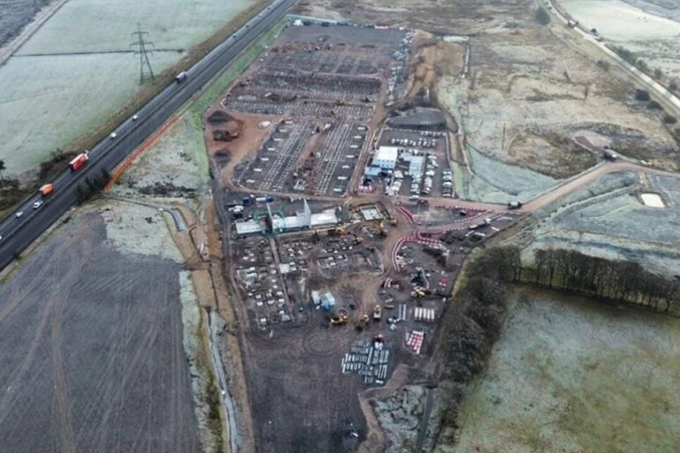
The equipment for this project was supplied by the energy storage business subsidiary of Canadian Solar, e-STORAGE. The contract covers a total of 1,170MWh of SolBank battery energy storage units and includes system integration, commissioning, and long-term operation and maintenance services.
CIP partner Nischal Agarwal said that this project will enhance the flexibility and resilience of the UK’s power system, promote the grid connection and consumption of more renewable energy, and help reduce the electricity costs for end users.
Coalburn 1 battery energy storage project is one of the three grid-connected battery energy storage projects developed by CIP in Scotland.
The other two battery energy storage projects are the on-site expansion of Coalburn 2 battery energy storage project (500MW) and the Devilla battery energy storage project located near Fife (500MW). The total scale of these three battery energy storage projects is 1.5GW/3GWh. The Coalburn 2 battery energy storage project and the Devilla battery energy storage project reached the final investment decision (FID) in January 2026 and are expected to start construction in 2027.
Before the official operation, CIP agreed to sell 50% of the ownership of the Coalburn 1 battery energy storage project to the investment institution AXA IM Alts. This marks the first time that AXA IM Alts has ventured into the UK’s energy storage sector. The transaction was completed through CIP’s “Copenhagen Infrastructure V” fund, which has raised over 12 billion euros (approximately 13.57 billion US dollars) for renewable energy investments in Europe, North America, and Asia-Pacific regions.
In terms of asset management, RES is responsible for the daily operation and management of the project, and the Coalburn battery energy storage project is thus included in RES’s global operation service portfolio covering over 43GW of wind power plants, solar power plants, energy storage systems, and green hydrogen facilities.
Meanwhile, SSE Energy Markets has signed a ten-year optimization agreement for deploying three energy storage projects in Scotland; CIP has also signed a 15-year capacity market agreement for the Coalburn 1 battery energy storage project, providing a stable fixed income source for it beyond market-based transactions.
The restrictions of the Scottish power grid and the adjustment of grid connection policies have shaped the investment logic for battery energy storage systems in the region.
The Scottish region has abundant onshore and offshore wind resources, but due to limited transmission grid capacity, wind power is often discarded to avoid grid overload. This contradiction makes the region a hotbed for battery energy storage system developers – the battery energy storage system can effectively store the discarded power and provide grid balancing services.
Previously, a CIP-related person stated that the battery energy storage combination deployed in Scotland will strongly support the UK’s net-zero emissions target, while reducing user costs and enhancing energy security. The balancing mechanism and intraday electricity trading are expected to become the main sources of income for these three projects.
The economic viability of the projects has also been affected by the ongoing debate over the UK’s grid connection policy. As part of the review of the Electricity Market Arrangements (REMA), the UK government is considering introducing “non-guaranteed grid connection rights” for new energy storage projects, aiming to accelerate the grid connection speed of energy storage systems, but this also means that newly built renewable energy power generation facilities may be restricted without compensation. Regarding this, CIP Company believes that the risk of significant revenue loss resulting from such policy changes is relatively low overall, because the energy storage systems themselves already have the characteristics of seeking benefits and avoiding harm, and often operate in a way that alleviates rather than exacerbates grid restrictions; however, it also advocates that a phased transition and coordination with transmission capacity expansion and upgrading should be adopted instead of suddenly changing the grid connection rules.
Since the large-scale deployment of energy storage systems in 2018/2019, the capacity of battery energy storage systems operated in the UK has grown rapidly. According to the “UK Battery Energy Storage Project Database” of Solar Media Company, currently, the total capacity of operating battery energy storage systems in the UK has exceeded 7 GWh.