
Recently, the market research firm Wood Mackenzie predicted that the scale of the US energy storage market will increase by nearly four times in the next six years.
On June 23rd, Wood Mackenzie released its 2026 second-quarter U.S. energy storage monitoring report. The report predicts that by 2031, the cumulative deployment scale of energy storage systems in the U.S. energy storage market will reach 200 GW/655 GWh.
In the first quarter of 2026, the US energy storage market witnessed a strong growth, and all sub-markets set new records.
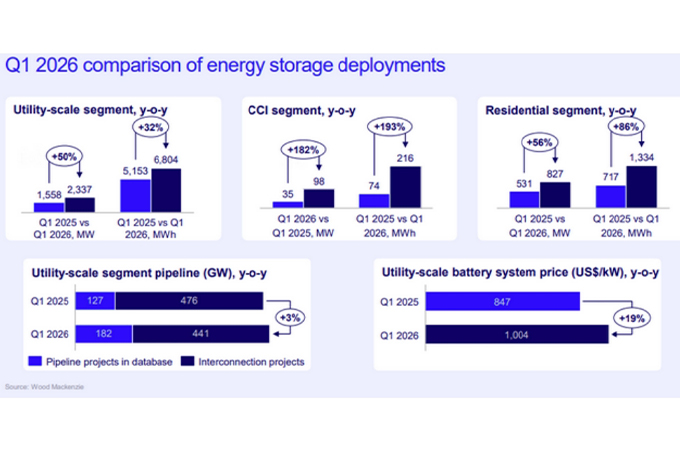
According to this report, the United States deployed 3.3 GW/8.4 GWh of energy storage systems in the first quarter of 2026. All market segments set new deployment records for the first quarter of the year.
The scale of the utility-scale energy storage systems deployed by the United States in the first quarter of 2026 reached 2.3 GW/6.8 GWh. This was mainly due to the fact that energy storage developers implemented the “Safe Harbor” measures in the second half of 2025, prioritizing to ensure that the energy storage projects could obtain development qualifications.
The installed capacity of commercial and industrial (C&I) energy storage systems deployed by the United States in the first quarter of 2026 reached 97.7 MW. This represents a year-on-year increase of 27%, with California accounting for 75 MW.
In the first quarter of 2026, the storage capacity of residential energy storage systems deployed by the United States reached a record high of 1.3 GWh. This represents an 86% year-on-year increase and a 5% month-on-month growth. This was due to the expiration of the 25D tax credit policy at the end of 2025, which led to a significant surge in the scale of deployed energy storage systems.
Utility-scale energy storage market: Traditional markets still dominate, while emerging markets are emerging.
Texas, California and Arizona continue to lead the U.S. in energy storage deployment for the first quarter of 2026, while emerging markets with vertically integrated utilities (particularly Michigan and Georgia) are experiencing an increasing growth momentum.
In its report, Wood Mackenzie predicts that utility-scale energy storage systems will grow at an average annual growth rate (AAGR) of 7%, and are expected to accelerate their growth during the period from 2028 to 2031.
In the short term, market growth will be constrained by “safe harbor” capacity limitations and the insufficient supply of battery storage systems that meet the requirements of Foreign Entity of Concern (FEOC). However, as the domestic battery manufacturing capacity in the United States gradually increases, utility-scale storage systems are expected to meet the rising electricity demand, fill the power gap left by retired fossil fuel power plants, and support the grid connection of more renewable energy power generation facilities.
Although Texas and California are expected to remain the core markets during the forecast period, emerging markets such as New York and Illinois will achieve higher growth.
Industrial and Commercial (C&I) Energy Storage Market: California Leads with Record Highs, Growth in Community Energy Storage Projects Across Multiple States
In the first quarter of 2026, California deployed a record 74MW of industrial and commercial (C&I) energy storage systems. With policy support such as net billing tariff (NBT) and self-generation incentive program (SGIP), it is expected to maintain a growth trend throughout 2026.
Meanwhile, Illinois, Maryland, Massachusetts and New York have been experiencing continuous expansion in the community energy storage market, with the total installed capacity of energy storage projects exceeding 215MW.
It is projected that during the period from 2026 to 2031, the annual deployment volume of industrial and commercial (C&I) energy storage systems in the United States will grow at a compound annual growth rate of 27%.
California’s strong performance in the first quarter of this year is expected to drive the commercial and industrial (C&I) energy storage market to remain active until 2023. With the continuation of the investment tax credit (ITC) policy, both integrated and standalone energy storage systems will see greater adoption – solar power plant developers are actively incorporating energy storage systems into their project portfolios. Community-based energy storage projects are also well-received in the short and long term.
Residential energy storage market: Storage capacity ratio reaches new high, but may slightly decline in 2026
In the first quarter of 2026, the storage capacity ratio of residential solar power generation facilities in the United States rose to 45%, higher than 38% in the same period of 2025 and remaining the same as in the fourth quarter of 2025. California, Texas, Hawaii and Arizona saw the largest month-on-month increase in household energy storage deployment in the first quarter of this year.
However, Wood Mackenzie predicts that the size of the residential energy storage market in the United States will shrink by 5% in 2026. This is because the bankruptcy of Freedom Forever, a residential solar power installation company in the US, the limited availability of tax equity financing, and the latest update of licensing data have all led to a downward adjustment in the expected installation increment.
Overall outlook: Approximately 500 GWh will be added within five years. The short-term contraction expectation has been revised.
The report released by Wood Mackenzie is largely consistent with the forecast it made in the first quarter of this year. It still predicts that the US energy storage industry will add approximately 0.5 TWh of storage systems in the next five years.
Meanwhile, the company has withdrawn its previous judgment regarding the recent market contraction – due to the fact that a large number of energy storage projects began construction by the end of 2025 in order to qualify for investment tax credits (ITC), this compensated for the gap caused by the reduction in energy storage deployment activities in the middle of 2025. As a result, the overall outlook for the US energy storage market is more optimistic.