
In 2025, the number of hours with negative electricity prices in the German power market continued to rise, exceeding 570 hours. This trend indicates that merely relying on the flexibility upgrades of traditional power sources, the suspension of short-term subsidies, and local power rationing measures is no longer sufficient to effectively prevent the frequent occurrence of negative electricity prices. Therefore, the German government plans to revise the “Renewable Energy Law” again. The focus of the revision will no longer be on restricting the subsidy payments during negative electricity price periods, but on further adjusting the photovoltaic revenue mechanism to allow the price signal to once again guide power generation and investment behaviors.
This article takes the reform of German photovoltaic subsidies as the starting point to explain how negative electricity prices have evolved from a short-term market phenomenon into a structural issue in a high proportion of new energy system. The article focuses on analyzing the mutual influence among the rigidity of traditional power sources, battery frequency regulation, grid constraints, heat network absorption, and the revenue mechanism of distributed photovoltaic power generation. It also explores the implications of Germany’s reform experience for China’s understanding of the boundaries for new energy consumption and the reconstruction of price signals.
Cause analysis: Mismatch between system structure constraints and subsidy mechanisms
When the photovoltaic power generation is high, the electricity demand is insufficient, the power grid’s transmission capacity is limited, and the traditional power plants have reached their maximum output reduction limit, the power system will enter a state of “excess electricity and difficulty in rapid regulation”. Negative electricity price is precisely the manifestation of this severe imbalance between supply and demand in the market price.
Since 2008, negative electricity prices have emerged in the German short-term electricity market when there is an excess supply. The phenomenon of negative electricity prices has occurred in both the day-ahead market and the intraday market, and the statistics of negative electricity hours are usually based on the day-ahead market. Negative electricity prices not only reflect the severe imbalance between market supply and demand, but also indicate multiple problems faced by the system during periods of high proportion of new energy output: insufficient capacity reduction, narrowed absorption space, and blocked price transmission mechanism. The system margin here refers to the remaining space in the power system that can still be used to absorb fluctuations in new energy, regulate supply and demand deviations, and cope with network constraints, under the safety operation constraints.
According to market logic, when the electricity price remains negative, power generation units should respond to the price signal by reducing load or shutting down to avoid continuous losses. However, in actual operation, once the unit’s output drops to its flexibility limit, even if the price further decreases, it is difficult to continue reducing the power generation volume. This is mainly because the unit is constrained by factors such as heating demand, start-up and shutdown costs, contractual obligations, and opportunity costs, and has to maintain a minimum operating level. The part of the output that cannot be further adjusted according to market prices but still continues to operate constitutes the regular power generation base volume in the system.
In addition to the conventional power generation base capacity constrained by economic factors, there is also a portion of output that must be maintained for the sake of ensuring the safe operation of the system, namely the minimum safety output. It includes the minimum auxiliary service power required for frequency regulation backup, reactive power support, and re-scheduling backup, etc., and constitutes the technical lower limit for system operation. The conventional power generation base capacity and the minimum safety output jointly determine the reduction space for conventional units during periods of high output from new energy sources.
The grid structure constraints are an important physical trigger condition for negative electricity prices. Transmission bottlenecks hinder the cross-regional consumption of surplus electricity, exacerbating local supply-demand imbalances. Taking a certain region as an example, the ultra-high voltage direct current transmission channel from north to south has not yet been completed, making it difficult for the offshore wind power in the north to be fully sent to the industrial areas in the south. This results in regional power surplus, thereby increasing the probability of negative electricity price phenomena. Reducing grid bottlenecks not only enhances transmission capacity but also reduces reliance on re-scheduling reserves, which is a key structural measure to reduce the frequency and magnitude of negative electricity price occurrences; practice has also shown that vertical distribution network bottlenecks cannot be ignored either, and corresponding power margins still need to be reserved in the local network.
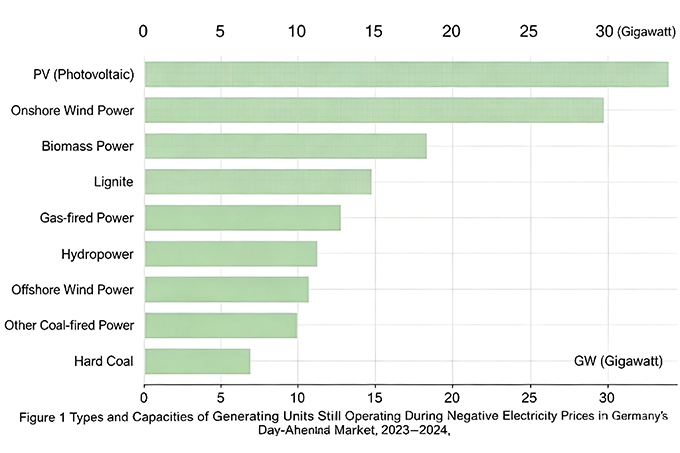
Apart from systemic structural issues, some new energy sources continue to generate electricity during periods of negative electricity prices. There are two main reasons for this: Firstly, projects that receive fixed subsidies will lose their subsidy income if they shut down. Secondly, projects without subsidies (such as most household photovoltaic systems) lack the ability to automatically adjust their output based on market prices. Thus, negative electricity prices not only reveal the insufficient downward adjustment space of the system, but also indicate that the revenue mechanism and control capabilities of some new energy sources have not yet matched the system’s boundary conditions. Recent market data in Germany further confirm that photovoltaic power has become one of the significant factors exacerbating negative electricity prices (see Figure 1).
Flexible transformation: Structural measures to alleviate negative electricity prices
The flexibility transformation of traditional power plants was once regarded as an effective measure to solve the problems of negative peak load and negative electricity prices, and it played an important role in Germany. Currently, most of the qualified power plants have completed the transformation, and the key indicators include the minimum safe output, the climbing rate, and the startup time. However, due to physical limitations and the lifespan of the power plants, the minimum operating output of traditional units is usually still between 20% and 40%, and the marginal space for further reducing the output is very limited.
A survey conducted by the German Federal Network Agency revealed that 30% to 40% of the power plants continued to operate under negative electricity prices, mainly due to heating constraints. To address this issue, heating operators are adding large-capacity electricity-to-heat modules. When negative electricity prices occur, they can suspend the operation of cogeneration units and instead utilize electricity-to-heat and heat storage technologies to meet heating demands at a lower cost, thereby effectively reducing operational losses.
The participation of traditional power plants in frequency regulation is one of the main reasons that limit the further reduction of their minimum safe output. With the entry of battery energy storage systems into the frequency regulation market, the reliance on traditional thermal backups has significantly decreased. After centralized batteries enter the primary frequency regulation market, the price sorting clearing mechanism has lowered the overall price, causing high-cost power sources such as nuclear power, hard coal power plants, and biomass power plants to gradually exit this market. Currently, the pre-certified capacity of centralized batteries for primary frequency regulation has exceeded the domestic demand in Germany, not only meeting the domestic market but also covering the maximum allowable export capacity. Nevertheless, pumped storage still maintains a certain advantage in terms of average clearing prices.
In the secondary frequency regulation market, the pre-certified capacity of battery energy storage systems has even grown more than that in the primary frequency regulation market, while hard coal power plants have almost completely withdrawn. Looking ahead, as the capacity of long-duration batteries continues to increase, batteries are expected to work in synergy with pumped storage, further replacing traditional frequency regulation power plants, thereby effectively reducing the minimum safe output level of traditional power plants.
To address the grid structure constraints, the grid needs to be expanded, but this process takes a long time. For instance, a super-high-voltage direct current transmission channel extending from northern Germany to southern Germany is expected to be completed by 2028. Meanwhile, after the longitudinal expansion of transformers in the northern German region, the required backup capacity for scheduling has significantly decreased, and the “price-insensitive power generation” during the negative electricity price period has reduced by approximately 30%.
From this, it can be seen that the flexibility upgrades of traditional power plants, the substitution of frequency regulation power plants with batteries, and the expansion of the power grid have, to a certain extent, lowered the technical operational limit of the system and alleviated some network bottlenecks. However, with the rapid growth of photovoltaic installations, especially in the context of a large number of household photovoltaic systems being connected, the core of the negative electricity price issue is gradually shifting from the insufficient flexibility of traditional power sources to the insufficient controllability of distributed generation and the distortion of the revenue mechanism.
Market Regulation: Growth of Distributed Photovoltaic and the Failure of Price Signals
The policy regulation of negative electricity prices in Germany has gone through several stages. As early as 2014, the government introduced the “6-hour rule”, which stipulated that when negative electricity prices persisted for more than 6 hours, the subsidies for new energy sources would be suspended. However, this measure did not effectively curb the phenomenon of negative electricity prices. Subsequently, the rule was gradually tightened to “4 hours” and “3 hours”, and was once regarded as an effective means to suppress negative electricity prices. For example, in 2021 and 2022, the number of hours of negative electricity prices in Germany decreased significantly (see Figure 2).
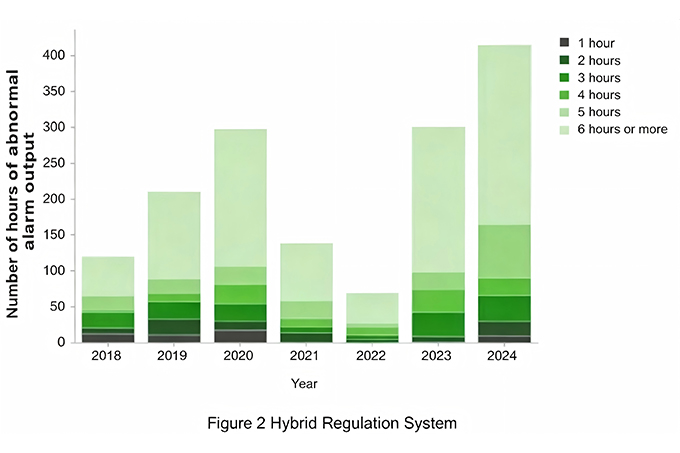
From 2023 to 2024, the issue of negative electricity prices once again resurfaced, with both frequency and magnitude increasing. One of the key reasons for this was the significant growth of residential photovoltaic systems. Most of these systems are unable to sense market prices and lack the ability to adjust, and continue generating electricity during negative electricity price periods, further exacerbating the imbalance between supply and demand. Especially after the restrictions on small-scale photovoltaic peak shaving gradually relaxed, this trend became even more pronounced.
In order to further reduce the duration of negative electricity prices, the German government introduced the “Photovoltaic Peak Shaving Law”, stipulating that during the period of negative electricity prices, newly installed photovoltaic systems will no longer receive electricity price subsidies. However, small photovoltaic systems with an installed capacity of no more than 2 kilowatts (such as rooftop photovoltaic systems) are not subject to this restriction and can still continue to receive subsidies.
At the same time, in order to enhance the regulatory capabilities for distributed photovoltaic power, Germany plans to achieve full coverage of “accessibility, controllability, schedulability and metering” for household photovoltaic systems by 2028, and mandatory installation of controllable smart meters will be required. Before this transformation is completed, the output of unmodified photovoltaic power stations will be restricted, with the maximum not exceeding 60% of their installed capacity. Additionally, according to the newly revised “Photovoltaic Peak Shaving Method”, starting from March 1, 2025, photovoltaic users in the controllable mode can receive an additional subsidy of 0.6 euros per kilowatt-hour.
However, these measures have failed to reverse the trend of the negative electricity prices continuing to rise. The crux of the problem is not merely the lack of technical capabilities, but rather the fact that the revenue structure of photovoltaic power generation has long been disconnected from the balanced and sufficient state of the power system. When the system already has excess electricity and is moving towards a direction of insufficient regulation capacity, some photovoltaic projects still continue to generate electricity on the grid according to the existing revenue mechanism, and the price signal cannot effectively change their power generation behavior.
Further analysis reveals that some household photovoltaic users in Germany do not decide the timing of generating electricity or connecting to the grid based on market price signals. Instead, they aim to maximize the revenue from grid connection under a fixed subsidy mechanism. As long as the subsidies can cover their expected revenue, negative electricity prices are unlikely to prompt them to change their generation behavior. The essence of the problem lies in that the subsidy mechanism separates users from market prices, preventing the negative electricity prices, which should reflect the system’s excess capacity, from effectively being transmitted to the operational decisions of distributed photovoltaic systems. Therefore, the management of negative electricity prices cannot merely rely on technical aspects such as output control, intelligent metering, and curtailment rules; it must also further address the photovoltaic revenue mechanism itself.
Key adjustments: Reform of the fixed subsidy mechanism and reconstruction of price transmission
To address the root cause of the problem, the German government has decided to revise the “Renewable Energy Law” in 2027. The reform draft has for the first time touched upon the core logic of photovoltaic income, and the main directions include: eliminating the fixed subsidies for photovoltaic systems under 25 kilowatts, encouraging an increase in the proportion of self-generation and self-consumption, reducing rigid grid connection, and instead implementing differential subsidies based on the market value of photovoltaic power – this is not a complete abolition of subsidies, but rather making the subsidy income dynamically adjusted according to changes in market prices.
At the same time, the reform will also expand the obligations for direct marketing, raise the requirements for measurement and controllability, tighten the restrictions on access to the network, and eliminate the annual electricity growth path. The core purpose is not simply to reduce support measures, but to restore the role of price signals in constraining the decision to install equipment and the behavior of accessing the network.
When the returns are once again constrained by the system’s boundary conditions, the installation behavior will tend to become rational. With reduced rigid injection and decreased frequency of boundary triggering, the system’s balance margin can gradually be restored, and the previously severed price transmission relationship is also expected to reconnect.
Therefore, the essence of this round of reform is not to reduce support for photovoltaics, but to rebuild the price transmission mechanism, so that the benefits of new energy can be re-matched with the system boundary conditions. After new energy enters the high-proportion stage, the subsidy policy cannot simply encourage the expansion of installations, but should guide the output and investment to conform to the system boundary. Otherwise, the subsidy will instead protect the rigid on-grid income during negative electricity prices periods, leading to boundary pressure and externalization of system costs, and ultimately being borne by users and taxpayers.