
In the landscape of clean energy technology, an event of significance occurred in 2025: the levelized cost of electricity (LCOE) for battery storage dropped to its lowest point ever. According to the annual electricity cost report released by BloombergNEF, the LCOE of the global benchmark four-hour battery storage project plummeted by 27% year-on-year in 2025, reaching $78 per megawatt-hour – this is the lowest value recorded by BloombergNEF since it began tracking this data in 2009.
What does this figure signify? You see, just a few years ago, the cost of battery storage was over $200 per megawatt-hour, and was regarded by many as a “pretty but impractical” technology. But today, its cost has dropped below that of a newly-built combined-cycle gas turbine power station (102 dollars per megawatt-hour), and it has formed a direct competition with many traditional fossil fuel power generation methods. This is not a gradual improvement, but a true cost revolution.
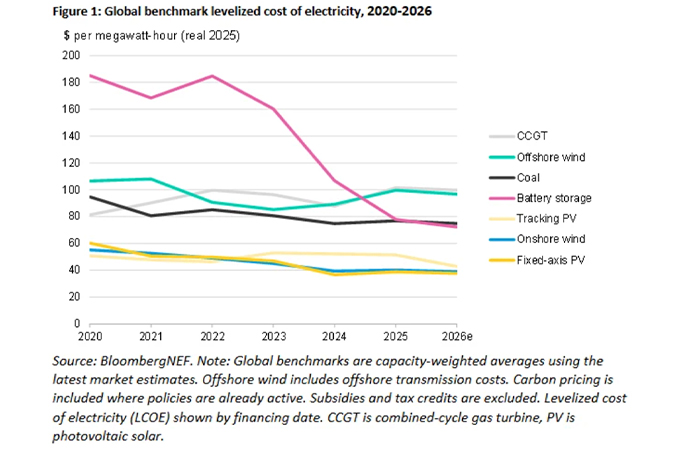
The forces driving this change come from multiple directions working together. Firstly, the spillover effect of the electric vehicle market. Over the past few years, the explosive growth in global electric vehicle sales has driven large-scale manufacturing investments in battery power, with China being particularly prominent. This excess capacity at the manufacturing end has led to continuous reductions in cell costs, which have directly affected the price structure of large-scale energy storage systems. Secondly, the fierce competition among manufacturers has forced the entire supply chain to continuously optimize and improve production efficiency. The third factor is the advancement in system design – improvements in battery management systems, inverter efficiency, and overall integration solutions have significantly enhanced the performance of systems at the same cost.
Meanwhile, a notable trend is accelerating: the rapid growth of integrated photovoltaic-storage projects. By 2025, developers added 87 gigawatts of combined photovoltaic and storage projects, with an average electricity cost of only $57 per megawatt-hour. This indicates that when solar energy and storage systems are deployed together, the overall power generation cost is even lower than that of a purely photovoltaic project. Storage is no longer an accessory but has become an indispensable core component in the renewable energy system.
This trend holds much more significance for the energy system than just the cost figures themselves. From the perspective of the design logic of the power system, the significant reduction in storage costs is driving a fundamental transformation: shifting from relying on fossil energy for peak shaving to a flexibility resource allocation centered on storage. Traditionally, gas power plants have played the role of “peak shaving” and “standby” in the power grid because they can start and stop quickly as needed. Today, battery storage systems are increasingly taking on this function without burning any fossil fuels. In the United States, due to the surge in demand for data center construction, the purchase cost of gas turbines has doubled in just two years, while wind power has once again surpassed gas as the cheapest option for new power generation in the United States. A report by Bloomberg New Energy Finance states that in some areas of California and Texas, combined photovoltaic and storage projects can already meet the large power demands of data centers at a lower cost.
Of course, the report also reveals an asymmetrical reality: while the cost of battery storage has been continuously declining, the costs of solar power, onshore wind power, and offshore wind power have all rebounded to varying degrees in 2025. The cost of solar power per kilowatt-hour has increased by 6% year-on-year, onshore wind power has slightly risen, and the global average cost of offshore wind power has even increased by 12%. Supply chain shortages, rising financing costs, and local market reforms are the main drivers. The cost of electricity per kilowatt-hour for offshore wind power in the UK is now 69% higher than it was five years ago. This indicates that the decline in the cost of renewable energy has never been linear, and the differentiation and competition among different technological routes are still ongoing.
However, the overall direction is clear. Bloomberg New Energy Finance predicts that by 2035, the cost of solar power per kilowatt-hour will drop by another 30%, battery storage will decrease by 25%, onshore wind power will drop by 23%, and offshore wind power will drop by 20%. As the cost of storage continues to approach $50 per megawatt-hour or lower, its deep integration with renewable energy will fundamentally change the underlying logic of global power generation economics. The old era dominated by coal and gas power and supplemented by storage is being replaced by a new paradigm where storage takes precedence and flexible scheduling is prioritized.