
Recently, the market research firm Wood Mackenzie stated in its report that the construction boom of data centers is boosting the development prospects of various sub-sectors of battery energy storage systems in the United States.
On September 23rd, Wood Mackenzie released the “U.S. Energy Storage Monitoring” report for the third quarter of 2026. The report predicts that as cost reductions drive the deployment of energy storage systems in new regions and new application scenarios, the installed capacity of energy storage systems deployed in the United States over the next five years (measured in MW) will increase by more than 50%.
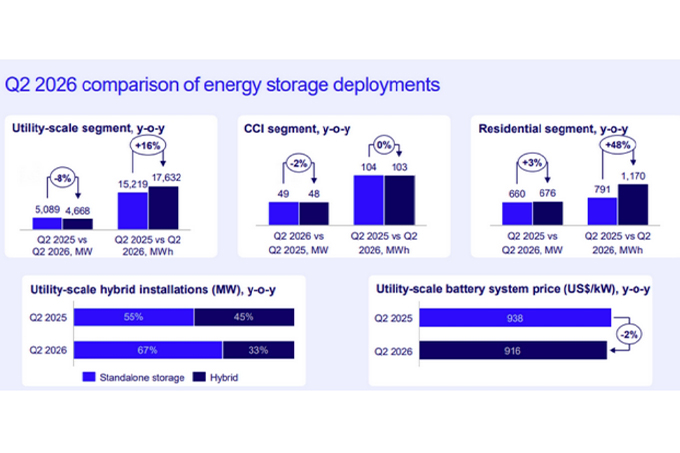
According to the report, although the total installed capacity decreased by 7%, the United States deployed a record 5.4 GW/18.9 GWh of battery energy storage systems in the second quarter of 2026. Even though the installed capacity declined, longer-duration utility-scale and residential energy storage systems continued to drive the growth of the total energy storage capacity. In the second quarter of 2026, the utility-scale battery energy storage systems deployed in the United States reached 4.7 GW/17.6 GWh; as the major markets approached saturation, the total installed capacity of energy storage systems decreased by 8% compared to the previous quarter.
The United States deployed 48 MW of energy storage systems in community-scale and commercial and industrial (CCI) segments, which returned to previous deployment levels.
The deployment of residential battery energy storage systems declined for the third consecutive quarter in 2026, dropping by 15% to 676 MW, due to factors such as the gradual cancellation of tax credits, consumer uncertainty, and difficulties in adapting to the transition to third-party ownership (TPO).
The deployment of battery energy storage systems in the United States in the second quarter of 2026, as reported by Wood Mackenzie, was slightly lower than the figures in the US Energy Storage Market Outlook (ESMO) report released a few weeks ago. This report was issued by the US Solar Energy Industries Association (SEIA) and research institution Benchmark Mineral Intelligence. According to the latest version of ESMO, in the second quarter of 2026, all sub-sectors of the energy storage market in the United States deployed 6.7 GW/20.2 GWh of energy storage systems.
Energy Storage Deployment Forecast in the United States
As mentioned above, Wood Mackenzie stated that with the cost reduction enabling energy storage systems to enter new regions and new application scenarios, the installed capacity of battery energy storage systems in the United States will increase by more than 50% in the next five years.
Due to the need to balance the growing load and the power generation capacity of renewable energy, it is expected that the deployment scale of utility-scale energy storage systems will grow at an annual rate of 8% over the next five years.
In the report, Wood Mackenzie stated that in the second quarter of 2026, California deployed a long-duration energy storage (LDES) project, and Texas deployed an energy storage project supported by a utility contract.
In June, REV Renewables and its parent company, US energy industry developer and investor LS Power, launched the state’s first 8-hour battery energy storage system – the Tumbleweed battery energy storage project in Kern County, California.
As energy storage deployments expand from California to emerging markets such as Maryland and Texas, it is expected that the commercial and industrial (CCI) battery energy storage market will grow by 27% from 2026 to 2031.
The growth in the size of commercial and industrial (CCI) battery energy storage systems in Hawaii, New Mexico, and Texas partially mitigated the overall decline, while New York and Massachusetts continued to rank among the best-performing markets in this segment.
In September, the Massachusetts Department of Energy Resources (DOER) announced the allocation of approximately $40 million in funds to 36 battery energy storage projects through the “Promoting Massachusetts Energy Storage Incentive Program.”
The deployment scale of residential battery energy storage systems is expected to decline by 4% in 2026, and then recover growth from 2027 to 2031, with an average annual growth rate of 9% during this period.
The top five markets in the United States (California, Texas, Puerto Rico, Arizona, and Illinois) accounted for 88% of the installed energy storage capacity in the second quarter of 2026, but all five markets experienced a month-on-month decline. It is worth noting that Puerto Rico saw the largest decline, dropping from 129MW in the first quarter to 73MW in the second quarter.
Recently, Sunrun, a company specializing in distributed energy resources (DER), and Tesla announced that on September 9th evening, residential battery energy storage systems operating in California discharged more than 580MW peak power through a joint virtual power plant (VPP) into the state’s grid.
In July, FranklinWH Energy Storage, a home energy management and battery storage system manufacturer based in the San Francisco Bay Area, announced that it had been selected to participate in two virtual power plant (VPP) projects in Texas.
In April, the Puerto Rico Energy Agency (PREB) approved the proposals of Tesla, Sunrun, and the residential solar power installation company SunStrong Management to automatically include participants in the emergency capacity resource plan established by the Puerto Rico Power Authority (PREPA) management committee.
In August, the residential energy storage startup Base Power announced the completion of a $1 billion D-round financing, with a post-valuation of $13 billion; in June, the company expanded its business to Illinois and deployed battery energy storage systems for ComEd’s customers.
The impact of the data center construction boom on the US energy storage market
According to a report by Wood Mackenzie, the data center construction boom has boosted the development prospects of all sub-sectors of the US energy storage market. The report states that energy storage systems can provide the required capacity faster, cheaper, and more reliably than relying solely on natural gas.
The company said that as ultra-large-scale data center operators increasingly encounter grid connection restrictions, utility-scale energy storage systems will help data centers obtain power more quickly – both through on-site deployment to manage asset loads and to meet the evolving grid demands at the power system level.
The value proposition of distributed energy storage systems is expanding from customer-centric advantages to grid services, as the industry is positioning virtual power plants (VPP) as “key enablers of load growth.”
Between 2026 and 2031, more than 130GW/534GWh of utility-scale battery energy storage systems will be deployed. With changes in the supply chain landscape, the utility-scale battery energy storage market will experience a growth stagnation in 2026 and 2027. Wood Mackenzie predicts that by 2031, the cumulative deployment of battery energy storage systems in the US will reach 207GW/715GWh, higher than its previous forecast. Meanwhile, the authors of the ESMO report of the American Solar Energy Society (SEIA) and Benchmark Mineral Intelligence predict that by 2030, the total energy storage capacity scale of the deployed energy storage systems in the US will reach 683GWh.
The growth of energy storage deployment scale will resume in 2028; with the expansion of domestic battery manufacturing scale in the US, the market will grow at an annual rate of 11% from 2026 to 2027. The market recovery will be driven by factors such as energy storage deployments for managing large loads, accelerated deployment of renewable energy before the expiration of the production tax credit (PTC) in 2030, and state-level incentives.
In August, Raafe Khan, the head of energy storage and emerging markets at the consulting firm Camelot Energy, discussed the integration of battery energy storage systems with data centers in an interview with industry media. He said: “Even if the construction of data centers slows down for any reason, I don’t think battery energy storage systems will be disproportionately impacted like natural gas power plants.”
In the “U.S. Energy Storage Monitoring” report by Wood Mackenzie for the third quarter of 2026, the company withdrew its previous expectation of a contraction in the U.S. energy storage market in the near future. The reason was that the number of projects that started construction by the end of 2025 to secure investment tax credits (ITC) was record-high, which offset the gap caused by the reduction in projects in the middle of the year.